Showing posts with label plan. Show all posts

Monday, April 27, 2015

13 Habits of Stressed People

My entire blog has been about habits we need to develop as people with low stress levels. Today we're going to look at the habits of stressed people (hint...do the opposite!) This article was found here.
  • Drink too much caffeine. 
  • Constantly vent. Every once in awhile is good!
  • Obsess over things they can't change. 
  • Eat food that isn't healthy.
  • Get overwhelmed easily.
  • Don't get enough sleep.
  • Overanalyze.
  • Don't exercise. 
  • Overload their schedules.
  • Try to do everything on their own.
  • Focus on the bad instead of the good. 
  • Procrastinate.
  • Rush through life. 
Do some of these habits sound like you? Let's use the habits I've written about in previous posts to reduce our stress levels and promote peace! 
Photo from this link


Friday, February 20, 2015

"I'm Always Tired"


Hello friends! Are you chronically fatigued, stressed, anxious? Do you have poor memory, concentration, or thyroid issues? Did you mysteriously gain weight out of nowhere recently? If so, you may be one of 80% of the population with adrenal fatigue. If you live a fast-paced lifestyle or you have a lot of obligations and responsibilities your adrenal glands can be severely depleted, resulting in more stress and adrenal fatigue. Watch this video for some helpful tips on healing your adrenal glands and getting rid of adrenal fatigue for good!

Comment below with your thoughts! 

Thursday, February 12, 2015

7 Steps to Less Stress

Today I wanted to tell you about a lecture I heard from the Washburn University Counseling Services in my Wellness Concepts and Applications class. . These ladies and gentlemen are devoted to the mental and emotional well-being of Washburn students and they offer free counseling services to students and faculty. This particular message stuck out to me as a simple way to reduce stress in your life and I would love to share it with you! This 7-step program by WUCS is adapted from the book The Depression Cure: The 6-Step Program to Beat Depression without Drugs by Stephen S. Iladri, Ph.D.
Photo from http://paulbrooksblog.blogspot.com/2011/10/stressed.html

Step 1: Diet

According to the message, "a poor diet puts the body in a state of physical stress and weakens the immune system." Make sure you are making healthy food choices (including 5 servings of fruits and veggies each day) and eating normal portions on a normal schedule.

Step 2: Sunlight

Be outside in nature! Your body needs Vitamin D that you get from just spending time in the sun. Studies show that stress, depression, fatigue, immune system problems, and diseases are linked to vitamin D deficiency. This doesn't mean you should spend all your time sunbathing; it is recommended that we get 15-20 minutes of sunlight each day. Work on that gradual tan in the fresh air!

Step 3: Sleep

Sleep is healing. The best amount of sleep for adults is anywhere from 7-9 hours a night. I still feel sleep-deprived when I get around 7 hours, so my goal is to get a solid 9 hours of sleep every night! 

Step 4: Engaging Activities

Take time to develop your personal interests and hobbies. I really love reading, singing, painting my nails, and spending time with my family and friends. Maybe you love to build things or cook or watch TV or walk your dog. Invest in those hobbies if they bring you peace! 

Step 5: Social Support

Having someone in your life who you can really count on can greatly reduce the amount of stress you experience in a difficult time. When you don't have a support system, stressful situations can seem magnified. Make time to socialize outside of school or work at least 3 times a week-you'll find being with your friends relieves a lot of the tension you feel. 

Step 6: Physical Exercise

Not getting enough physical activity can put your body in a stressed state. I have to force myself to move around when I have a heavy week of homework because I know it is healthy for me. It is recommended that we get 2-3 total hours of physical activity each week. Pencil it into your calendar so you never have to worry about not having enough time. You might feel tired at first, but the amount of energy you'll get out of it will be so worth it.

Step 7: Strategic Activities

Strategic activities are the actions you purposefully take to get away from stress for a little bit. These differ for each person. For example, some people walk away from their stressful for 20 minutes to recharge, some find a quiet place to be alone, some make a to-do list (me me me), some meditate or pray, clean the house, or study something else. Whatever you choose to do, make sure it relieves your stress for the moment instead of adding onto it. 

What Steps do you need to work on in your life? How will changing that Step affect your stress level and productivity?

14 Habits I'm Trying to Keep

This is a quick list of ways to improve your time management. I am especially prone to procrastination because I am easily distracted (anyone else?) and it only results in more stress in my life as deadlines and due dates get nearer. When I manage my time wisely, I am able to devote more of my time to activities I enjoy- like slowly drinking a cup of coffee in the morning, reading my Bible, or adventuring with my friends- rather than always rushing to finish the next task or homework assignment. A professor gave me a worksheet with this list on it last semester and I have it posted in my dorm room; it's a good reminder to plan first so I can enjoy my time later!

1. Relax and "do nothing" for short periods each day.
2. Complete daily tasks by priority.
3. Do multiple errands at one time instead of one errand at one time.
4. Take action to further your goals instead of regretting past failures.
5. Schedule a regular 15 minute planning period to plan the next day.
6. Carry along small tasks you can complete when waiting in line or at the doctor's office.
7. Enjoy whatever you're doing, whether it's work or relaxation.
8. Set reasonable deadlines for yourself and those around you.
9. Determine whether a task is worth your time before beginning it.
10. Realize that some of your time will be spent on things beyond your control.
11. Delegate some of your responsibilities if they overwhelm you.
12. Concentrate on activities that work toward your future benefit instead of wasting time feeling guilty about what you can't do.
13. Remain confident in your judgement of priorities and refer to your prioritized plan when you face difficulty.
14. Complete your daily plan in consecutive order without skipping over difficult tasks.

What are your strategies for time management? Share them below in the comments! 

Friday, February 6, 2015

The Work Plan

Success depends upon previous preparation, and without such preparation there is sure to be failure. -Confucius
Preparation for the day is my biggest success tool to reducing stress in my life. I have found that when I write down my obligations, tasks, and goals for the day, I'm more motivated to complete them. (Do you feel a sense of satisfaction when you cross things off your list too? Do you write things you've already completed on your list just so you can cross them off?? Guilty.) I have two methods for you to keep yourself sane this semester! 

1. Keep a Planner

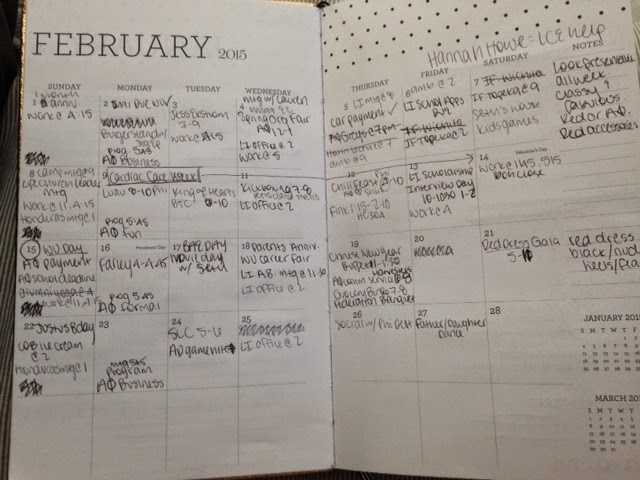
I keep a monthly/weekly planner that I write EVERYTHING in. Every meeting, every campus event, every birthday, every homework assignment, little reminders to myself...everything. This is where I plan my weeks and my month overall. Its my way of making sure I know when I have time to schedule things and it allows me to have peace about the upcoming week. I struggle with procrastination on homework (who doesn't) but this planner is my lifesaver. I plan my homework assignments 2 weeks in advance. I can flip to a certain day and see what homework I need to finish that night and whether or not I have free time. If I only have one chapter to read, sure I can go to Qdoba with you. 

Sidenote: I tried an electronic calendar, I really did. It's just not the same as physically writing things down and crossing them off when you finish. Maybe I'll try it again next semester. For now, give me paper and a pen. 

I took this picture so you could see a glimpse of my
February schedule. Write everything down! 

2. Write a Work Plan

In addition to planning my month and upcoming weeks, I like to take a few minutes in the morning to make a Work Plan for the day. Ann Voskamp at aholyexperience.com (one of my very favorite blogs) created a document that has revolutionized the way I plan my days. There is a place for you to write your Dire tasks that need the priority, Definite tasks to build habits- logging water and food intake, scripture memorization, working out, and your relationship focus, Daily tasks that you do every day without fail, Domestic tasks around the house (or dorm!), Doxology to remember to give thanks in every circumstance, a To-Do list for us girls who can't get enough of those, and the Day's Draft to plan out when you'll complete all this.If you don't finish all your tasks for the day, just move them over to the Dire section of tomorrow's Work Plan!

There is so much peace when we prepare and plan what we can. Of course, we cannot completely control what happens to us but when we recognize that there is grace in thankfulness and preparation, there is joy to be found! I'm choosing today to be prepared, thankful, intentional, and joyful. No more stress or sluggishness or confusion. Check out Ann's Work Plan and start the journey to live stress-free! 


What about you? What are your strategies for planning your days? Or if you don't do it the old-fashioned way, please help me understand this obsession with electronic calendars.